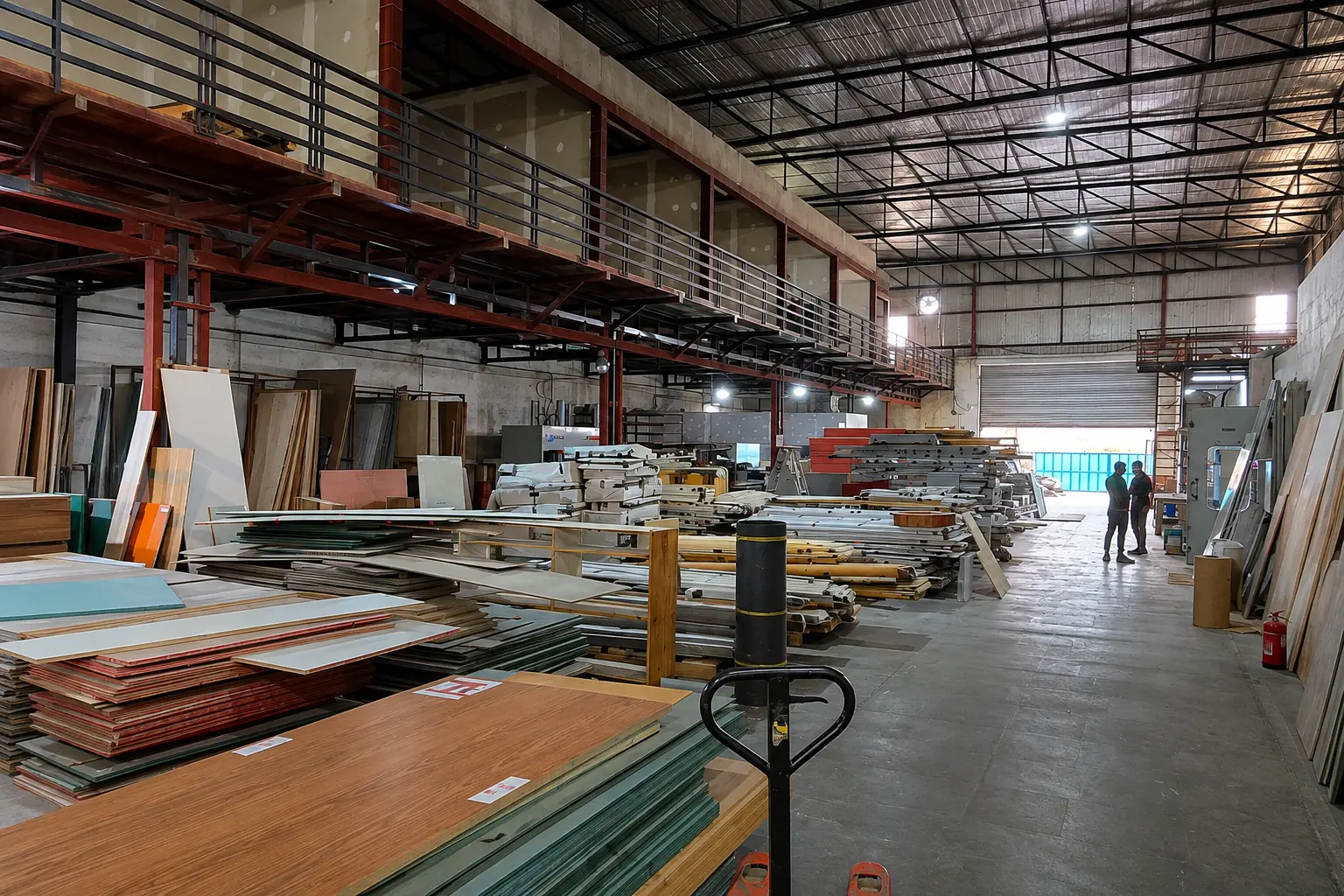
Modular Furniture Factory in Gurgaon: What Actually Happens Before Your Furniture Reaches Home

Modular Furniture Factory in Gurgaon: What Actually Happens Before Your Furniture Reaches Home

modular furniture factory in gurgaon

Introduction:

A modular furniture factory in Gurgaon manufactures pre-engineered furniture components — kitchens, wardrobes, beds, storage units — in a controlled factory environment, then assembles them on-site. Unlike carpenter-built furniture, factory-made modular pieces are cut on precision machines, so joints, finishes, and hardware fit consistently every time. Innovante Studio runs its own manufacturing unit in Gurgaon, handling design and production under one roof.

# Table of Contents
1Why the Factory Matters More Than the Showroom
2Carpenter-Built vs. Factory-Made: Where the Real Difference Shows Up
3What Actually Happens Inside a Modular Furniture Factory
4Materials You'll Come Across When Comparing Quotes
5What It Costs to Get Furniture Made in Gurgaon
62026 Shifts in How Furniture Gets Manufactured
7Where Homeowners Go Wrong When Choosing a Manufacturer
8Why Factory-Made Furniture Is Worth Choosing
9Inside Innovante Studio's Manufacturing Setup
10Who We Serve Across Gurgaon and Delhi NCR
11Wrapping Up
12Frequently Asked Questions

Why the Factory Matters More Than the Showroom

Most people shopping for furniture never think about where it's actually made. They walk into a showroom, like a finish, place an order, and assume the piece in front of them is what shows up at home.

It usually isn't — not exactly.

Showroom pieces are samples. What you get depends entirely on the factory behind that showroom: the machines it uses, the quality checks it runs, and whether it's cutting panels to the millimetre or eyeballing it on-site with a hand saw. Two furniture companies can show you the exact same wardrobe design and hand you two very different products, purely because of what happens before delivery — not after the order is placed.

That's really the whole argument for caring about the factory, not just the design catalogue.

Carpenter-Built vs. Factory-Made: Where the Real Difference Shows Up

Traditional carpenter-built furniture still has its place — for one-off, highly custom pieces, a skilled local carpenter can do wonders. But for kitchens, wardrobes, and anything with repeated modules, factory manufacturing wins on consistency almost every time.

Feature Carpenter-Built (On-Site) Factory-Made (Modular)
Cutting precision Manual, varies by worker CNC-cut, consistent to the millimetre
Finish quality Depends on site conditions, dust, humidity Controlled factory environment
Time to install Weeks of on-site carpentry Pre-built units, faster on-site assembly
Consistency across units Can vary piece to piece Identical specs across every module
Site mess Sawdust, noise, ongoing disruption Minimal — mostly assembly work
Repairs & replacements Hard to match old work exactly Modular parts can be swapped easily
Design flexibility High for one-off pieces High within modular systems

Neither approach is universally "better" — but if you're getting a kitchen or a full wardrobe system done, factory-made modular furniture is usually the safer, more predictable choice.

What Actually Happens Inside a Modular Furniture Factory

A lot of homeowners assume "modular" just means "assembled from a kit." It's more involved than that.

  • Design and measurement. Before anything gets cut, the space is measured precisely — often digitally — so every panel is sized for your actual room, not a generic template.

  • Material selection and cutting. Boards are cut using CNC (computer-controlled) machines, which is where factory-made furniture pulls ahead of hand-built work. The cuts are exact, and edge-banding is sealed properly to keep moisture out.

  • Hardware fitting. Hinges, channels, and drawer systems are pre-fitted and tested at the factory, not improvised on-site.

  • Quality checks. Each module is inspected for alignment, finish, and hardware function before it ever leaves the factory floor.

  • Packing and transport. Finished units are packed to survive the trip from factory to home without damage — a step that's easy to underestimate until it goes wrong.

  • On-site assembly. Installation is largely mechanical at this point — fitting pre-made modules together — which is why it's faster and cleaner than traditional carpentry.

Materials You'll Come Across When Comparing Quotes

If you're getting quotes from different manufacturers, you'll hear a lot of material names thrown around. Here's what they generally mean in practice:

  • Plywood is the sturdier, more water-resistant base material — usually the better long-term choice for kitchens and high-moisture areas.

  • MDF (medium-density fibreboard) is smoother and cheaper, works well for painted or matte finishes, but handles moisture less well than plywood.

  • Laminate is a budget-friendly surface finish that's durable and easy to clean, available in a huge range of colours and textures.

  • Veneer is a thin layer of real wood applied over a base board — it gives a natural wood look and feel at a lower cost than solid wood.

  • Solid wood is the most premium and long-lasting option, but also the most expensive and the most sensitive to humidity if not treated properly.

None of these is automatically "wrong" — the right pick depends on the room, your budget, and how much maintenance you're willing to do.

What It Costs to Get Furniture Made in Gurgaon

Costs vary a fair bit depending on material, size, and finish, but here's a rough sense of where things typically land in Gurgaon and Delhi NCR:

  • Modular kitchens generally start from around ₹1.5 lakh and can go well past ₹10 lakh for larger, premium setups.

  • Modular wardrobes are usually quoted after a home visit, since pricing depends heavily on size, finish, and internal fittings.

  • Bespoke furniture pieces — beds, sofas, storage units — are priced individually based on material and complexity.

The honest advice here: don't compare quotes on price alone. Ask what material grade, hardware brand, and warranty are included, because two quotes that look similar on paper can be very different once you dig into the specs.

2026 Shifts in How Furniture Gets Manufactured

Manufacturing has quietly changed over the past couple of years, and it's worth knowing what's shaping the industry right now.

  • Factories are leaning harder into precision cutting technology, which cuts down on material waste and tightens tolerances even further.

  • Buyers are asking more questions about material sourcing — where the wood comes from, how sustainable the plywood core is — rather than just picking based on the surface finish.

  • Modular systems are expanding beyond kitchens and wardrobes into full room systems, so bedrooms, home offices, and even balconies are increasingly built from the same modular logic.

  • Faster turnaround has become a real differentiator. Homeowners don't want three-month waits anymore, and factories that can standardise more of the process without cutting corners are winning more business.

  • Hardware quality is getting more attention too — soft-close hinges, telescopic channels, and better internal fittings are no longer treated as "premium extras," they're closer to a baseline expectation now.

Where Homeowners Go Wrong When Choosing a Manufacturer

  • Picking purely on price. The cheapest quote often means a lower material grade or thinner boards — differences that only become obvious a couple of years in.

  • Not asking where the furniture is actually made. Some companies outsource manufacturing to third-party units with inconsistent quality control. Ask directly if they own their factory.

  • Skipping the warranty conversation. Hardware and hinges wear out. Find out what's covered and for how long before you sign anything.

  • Assuming all plywood is the same. Plywood grades vary significantly, and this is one of the easiest places for a manufacturer to cut costs without you noticing until later.

  • Not visiting the factory or asking for one. A manufacturer confident in their process usually won't mind you seeing where the furniture is actually built.

  • Ignoring site measurement accuracy. Furniture built off wrong measurements leads to gaps, misalignment, or units that simply don't fit — always confirm how measurements are taken and by whom.

Why Factory-Made Furniture Is Worth Choosing

  • Consistent quality across every module, since machines don't have "off days" the way manual cutting can.

  • Faster installation, with most of the work already done before it reaches your home.

  • Less on-site mess — no sawdust clouds, less noise, fewer days of disruption.

  • Easier repairs later, since modular parts are standardised and can be replaced individually.

  • Better long-term durability, particularly with sealed edges that resist moisture and swelling.

  • A cleaner overall experience, from order to installation, with fewer surprises along the way.

Inside Innovante Studio's Manufacturing Setup

Innovante Studio designs and manufactures its furniture in-house, rather than outsourcing production to third-party units. The studio has been in the industry for 25 years and has completed more than 400 residential, retail, and institutional projects.

A few things about how the setup works:

  • Kitchens, wardrobes, bespoke furniture, doors, and wall panels are all manufactured at the studio's own facility, which keeps quality control tighter.

  • The process runs from design and measurement through to manufacturing and final on-site installation, managed by one team.

  • Materials and hardware are selected upfront, with clients involved in choosing finishes before production starts.

  • The studio offers a free in-store consultation for anyone who wants to see materials and finishes in person before committing.

If consistency and accountability matter to you — and they should, for something you'll live with for a decade or more — knowing your furniture is made under one roof, by one team, is a reasonable thing to ask for.

Who We Serve Across Gurgaon and Delhi NCR

Innovante Studio's design centre and manufacturing base is located on Basai Road, Sector 11, Gurugram. From there, the studio serves clients across Gurgaon, including Golf Course Road, Sohna Road, and the DLF phases, as well as neighbouring parts of Delhi NCR such as South Delhi.

Being based locally means site visits, measurements, and installations don't involve long-distance coordination — something that matters more than people expect once a project is actually underway.

Wrapping Up

Furniture quality is decided long before it reaches your living room — it's decided on the factory floor, in the cut of the panel and the fit of the hinge. A modular furniture factory in Gurgaon that manufactures in-house, rather than outsourcing, gives you far more control over that process and far fewer surprises once the delivery truck shows up.

If you're planning a kitchen, wardrobe, or full home furniture project, it's worth asking any manufacturer you're considering exactly where and how the furniture is made — not just what it looks like in the showroom.

Frequently Asked Questions

It's a manufacturing facility where furniture components — kitchen units, wardrobes, storage systems — are cut, finished, and quality-checked using machines, then assembled on-site rather than built entirely by hand.
For repeated modules like kitchens and wardrobes, factory-made furniture is generally more consistent and durable. Carpenter-built work still has value for unique, one-off pieces.
Modular kitchens typically start around ₹1.5 lakh and can exceed ₹10 lakh depending on size and finish. Wardrobe and custom furniture pricing usually depends on a home visit and specific requirements.
Common choices include plywood, MDF, laminate, veneer, and solid wood — each with different price points, durability, and moisture resistance.
Manufacturing timelines vary by project size, but factory-made furniture is generally faster to install than fully carpenter-built work, since most fabrication happens before the site visit.
Yes. Innovante Studio designs and manufactures its kitchens, wardrobes, bespoke furniture, doors, and wall panels in-house at its Gurugram facility.
Innovante Studio offers a free in-store consultation where you can view materials and finishes in person before committing to a project.
Plywood is sturdier and more moisture-resistant, making it better for kitchens. MDF is smoother and more budget-friendly, often used for painted or matte finishes.
Yes, the studio serves clients across Gurgaon and the wider Delhi NCR region, including South Delhi, from its manufacturing base in Sector 11, Gurugram.
You can request a free consultation through the Contact Us page on innovante.co.in, or call the studio directly to schedule a home visit or factory tour.

get in touch

enquire here for further assistance
Thank you! Your submission has been received!
Oops! Something went wrong while submitting the form.