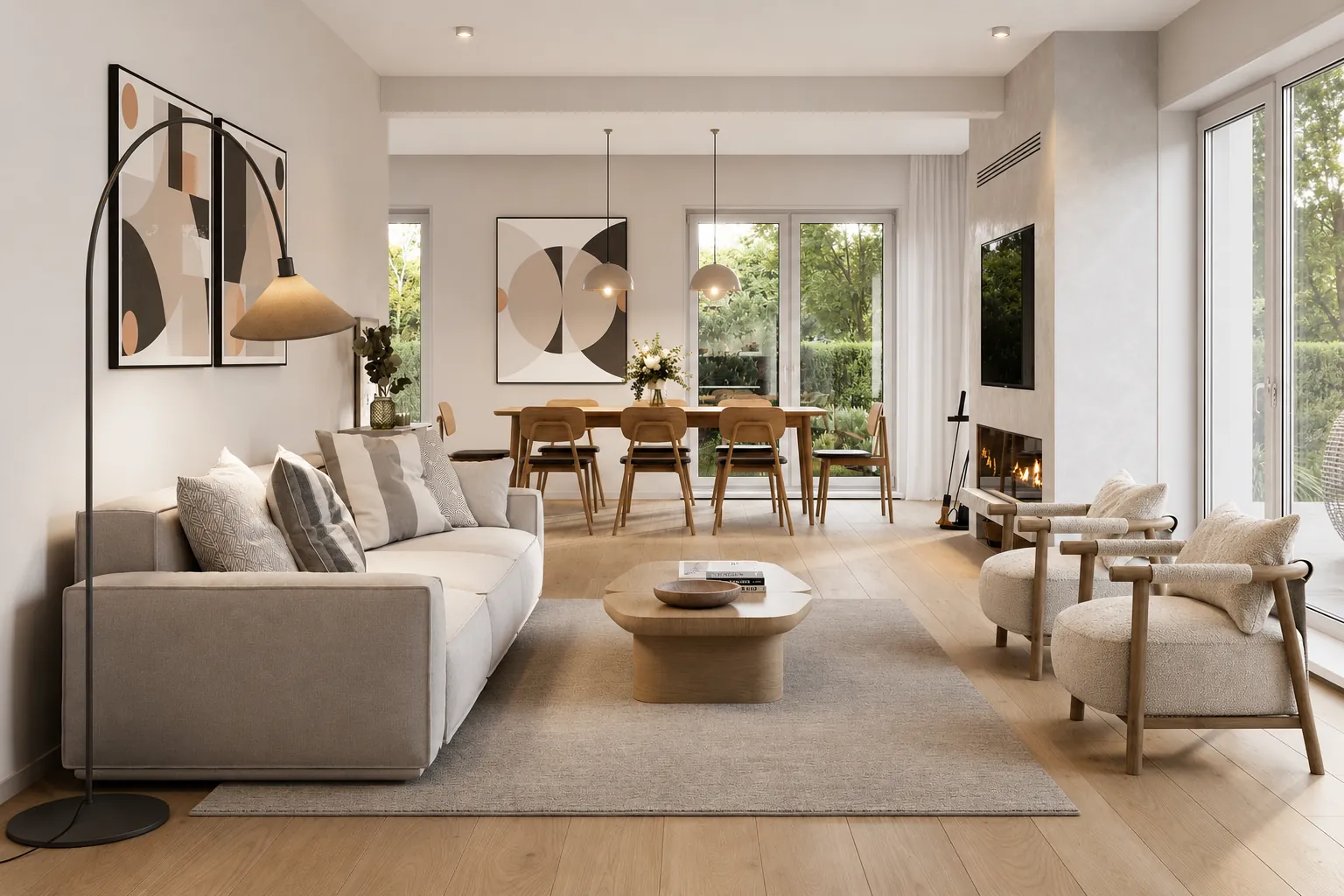
Luxury Interior Design in 2026: What It Actually Takes to Get It Right

Luxury Interior Design in 2026: What It Actually Takes to Get It Right

luxury interior design in 2026

Introduction:

Luxury interior design isn't really about the price tag on your sofa. It's the discipline of using premium materials, custom-made furniture, and a layout built around how you actually live — so the home feels considered rather than decorated. Done well, it should feel less like a showroom and more like the most comfortable version of you.

# Table of Contents
1Let's Get One Thing Straight About "Luxury"
2How to Tell You've Outgrown Your Current Home
3The Ingredients That Make an Interior Feel High-End
4What's Actually Trending in 2026 (Not the Pinterest Version)
5From First Call to Final Handover: How the Process Really Works
6Luxury vs. Standard Design — Side by Side
7Mistakes We See Homeowners Make, Over and Over
8Is It Actually Worth the Investment?
9Where Innovante Studio Fits Into This
10Areas We Design In
11Final Thought
12Questions People Usually Ask Us

1. Let's Get One Thing Straight About "Luxury"

Ask ten people what luxury interior design means, and you'll probably get ten different answers involving marble, chandeliers, or a very large budget. None of that is wrong, exactly. It's just incomplete.

What separates a genuinely luxurious space from an expensive-looking one is intention. Somebody made a decision about why that light fixture sits where it does. Why the sofa is that particular depth. Why the wardrobe opens the way it does instead of the way the showroom sold it to you.

You feel this the second you walk into a well-designed home, even if you can't articulate why. Nothing is fighting for attention. Nothing feels like it was added because it "matched." That's the part money alone can't buy — it takes a designer who's willing to say no to things that don't earn their place in the room.

2. How to Tell You've Outgrown Your Current Home

You don't need a five-bedroom villa to want better interiors. Most people who reach out to us aren't chasing luxury for its own sake — they've just hit a wall with what they have.

A few signals we hear a lot:

  • The house is tidy, but it still feels cluttered somehow.

  • Your furniture was bought for a life you don't live anymore — maybe you had a smaller family then, or a different job, or less stuff.

  • Friends compliment the address, never the interiors.

  • You're about to move and would rather walk into a finished home than spend the first six months "figuring it out."

If two or three of these sound familiar, that's usually the point where a proper design conversation makes sense.

3. The Ingredients That Make an Interior Feel High-End

There's no single trick here, but a handful of things tend to show up together in interiors that genuinely feel premium.

  • Real materials, not imitations. Natural stone, solid wood, brushed metal — these age well. A laminate that's trying to look like walnut ages badly, usually within a couple of years, and everyone can tell.

  • Furniture built for the room, not the other way around. Off-the-shelf pieces are made for an average room that doesn't exist. Bespoke furniture is measured against your actual walls, your actual light, your actual habits.

  • Lighting that does more than one job. A single overhead light flattens a room. Layering ambient, task, and accent lighting is what makes a space feel different at 8 AM versus 9 PM — which, frankly, is most of what "mood" means in design terms.

  • Restraint in colour. The most expensive-feeling homes we've worked on usually stick to three or four tones, used with discipline, rather than a rainbow of "statement" choices.

  • A layout that actually works for daily life. A kitchen that photographs beautifully but is a pain to cook in isn't luxury. It's a set.

4. What's Actually Trending in 2026 (Not the Pinterest Version)

Trends move fast in this industry, and half of what gets called a "2026 trend" online is really just last year's trend with a new hashtag. Here's what we're genuinely seeing in client briefs and on-site work right now.

  • Warm minimalism is winning over the stark, all-white look — think clean lines, but with wood tones and softer textures doing the heavy lifting instead of bare walls.

  • Curves are back. Rounded kitchen islands, arched doorways, curved sofas — after a decade of sharp angles, homes are softening.

  • Wellness corners have gone from "nice extra" to something almost every serious client asks about. A meditation nook, a proper reading chair, a small home-spa setup — people want a room that asks nothing of them.

  • Technology is expected but invisible. Nobody wants to see the smart panel. They just want the lights to dim on cue and the AC to already know it's hot.

  • Kitchens have quietly become the most important room in the house, designed with the same care that used to be reserved for the living room.

  • Sustainability isn't a separate checkbox anymore — durable, responsibly sourced materials are just part of what "premium" is expected to mean now.

5. From First Call to Final Handover: How the Process Really Works

People are often surprised by how structured this is. It's not "pick a colour and hope for the best."

  • A conversation, first. Before any design work starts, we need to understand how you live — not just what you like.

  • Concept and mood boards. This is where the direction gets set — palette, materials, general feel.

  • 3D visualisation. You should see your kitchen before it's built, not after.

  • Sourcing materials and vendors. Fittings, stone, wood — all finalised with your sign-off.

  • Locking the budget. No surprises halfway through. This step matters more than people expect.

  • Execution. Civil work, carpentry, electrical — managed on-site so you're not chasing five different contractors.

  • Styling. Furniture placement, décor, final lighting adjustments.

  • Handover. You get the keys to a home that's actually finished, not "almost done."

6. Luxury vs. Standard Design — Side by Side

Feature Standard Interior Design Luxury Interior Design
Materials Laminate, standard plywood Natural stone, veneer, solid wood
Furniture Catalogue, ready-made Custom-fabricated for your space
Planning Fairly templated Built around your specific lifestyle
Project management Often DIY-coordinated Full turnkey, single point of contact
Lighting Basic fixtures Layered ambient, task, and accent lighting
Timeline Quicker, less detailed Longer, with 3D visualisation upfront
Cost Lower upfront Higher upfront, better long-term value

7. Mistakes We See Homeowners Make, Over and Over

  • Chasing trends instead of building something timeless. A home designed entirely around this year's aesthetic tends to look dated by the time the paint's fully dry. Mix trend pieces with foundations that won't embarrass you in five years.

  • Not talking budget early enough. Falling in love with a design before discussing what it costs is a recipe for disappointment. Have the money conversation on day one, not week six.

  • Treating lighting as an afterthought. It's the single most underrated element in a design, and the one that gets cut first when budgets tighten. Don't.

  • Filling every inch of space. More furniture isn't more luxury. Empty space is doing work too — it's what makes a room feel like it can breathe.

  • Designing for photos instead of daily life. A wardrobe that looks stunning but has terrible storage logic will annoy you every single morning.

  • Juggling separate vendors. Coordinating a carpenter, electrician, and painter on your own usually means delays and finger-pointing when something goes wrong. A turnkey partner removes that headache entirely.

8. Is It Actually Worth the Investment?

Short answer: usually, yes — if it's done properly.

Homes with genuinely well-executed interiors tend to hold their resale and rental value better. Premium materials cost more upfront but need far less repair or replacement down the line, which quietly evens out the maths over a few years. And there's a less measurable benefit too — a home built around how you actually live is simply easier to live in, day to day.

None of that means every rupee spent on "luxury" pays off. It only pays off when the design decisions are deliberate, not decorative.

9. Where Innovante Studio Fits Into This

We've been doing this for 25 years, based out of Gurgaon, with more than 400 completed projects across homes, offices, and retail spaces.

What we'd want you to know before working with any design studio, including us:

  • We handle the whole thing end-to-end — architecture and planning, design consultancy, turnkey execution, décor, lighting, even landscape and balcony work.

  • Our kitchens, wardrobes, furniture, doors, and wall panels are manufactured in-house, which means fewer surprises in quality control.

  • The process follows a clear structure — concept, budget, design, execution — so you always know what stage you're at.

  • We offer a free in-store consultation if you'd rather see and touch materials before committing to anything.

10. Areas We Design In

Most of our work is concentrated across Gurgaon (Gurugram) and the wider Delhi NCR region — Sector 11, the DLF phases, Golf Course Road, Sohna Road, and pockets of South Delhi. Our design studio and manufacturing unit are on Basai Road, Sector 11, Gurugram, which keeps site visits and consultations straightforward for clients across the belt.

If you're designing in this region, working with a studio that already knows the local building norms and material suppliers tends to save a fair amount of back-and-forth.

11. Final Thought

Luxury interior design was never really about spending the most — it's about spending with intention, on things that actually improve how a home feels and functions. The 2026 trends worth paying attention to all circle back to the same idea: a home should feel personal, not staged.

If you're at the point of wanting a home that reflects how you live rather than how a catalogue thinks you should live, working with a team that manages the whole process — not just the pretty parts — makes the difference.

12. Questions People Usually Ask Us

It's the use of premium materials, custom-built furniture, and layouts designed around a specific person's life — rather than generic, one-size-fits-all decorating.
Most luxury home projects here start around ₹2,000–₹5,000 per sq. ft., depending on materials, scale, and how complex the design is.
Usually 3 to 6 months, start to finish — sometimes longer for larger homes or heavy civil work.
Decoration is surface-level — colours, accessories, styling. Design goes deeper: layout, materials, function, and execution from the ground up.
Not necessarily. Some studios, including ours, handle architecture, planning, and interiors under one roof, which simplifies things considerably.
Natural stone, solid wood, high-grade veneer, brushed metal fittings, genuine leather — mostly chosen for how they age, not just how they look on day one.
Yes. Size has very little to do with it. A smart layout and well-made furniture can make a compact home feel far more premium than a large, poorly planned one.
Architecture and planning, design consultancy, turnkey execution, modular kitchens, wardrobes, bespoke furniture, doors, wall panels, décor, lighting, and landscape or balcony design.
Everything, if you want that — concept, sourcing, execution, and final handover, for both homes and offices across Gurgaon and Delhi NCR.
Through the Contact Us page on innovante.co.in, or by calling the studio directly to set up a visit to the Gurugram design centre.

get in touch

enquire here for further assistance
Thank you! Your submission has been received!
Oops! Something went wrong while submitting the form.